
Car window tinting in Folsom, CA can reduce glare, block UV rays, control solar heat, add privacy, and change the appearance of your vehicle. California also places strict limits on what can be installed on certain windows, so choosing a tint involves more than picking the shade you like best.
The front side windows, windshield, rear side windows, and back glass do not all follow the same rules.
That distinction matters for drivers in Folsom, CA, Sacramento, CA, Rocklin, CA & Rancho Cordova, CA who want better heat rejection without ending up with tint that does not meet California requirements.
Royal Tint installs Rayno Nano Carbon Ceramic automotive window film at our nearby Rancho Cordova location at 3515 Sunrise Blvd Suite #21, Rancho Cordova, CA 95742 and at our Rocklin location at 5600 Pacific St Suite 100, Rocklin, CA 95677.
If you live or work in Folsom and want help choosing window film, call our Rancho Cordova shop at (916) 502-2994, our Rocklin shop at (916) 840-0030, or contact Royal Tint online.
Table of Contents
- What Are the California Window Tint Laws?
- Front Side Window Tint Rules in California
- Can You Tint the Windshield in California?
- Rear Side Window and Back Window Tint Rules
- What Does VLT Mean for Car Window Tint?
- Why 70% Tint Does Not Always Mean 70% Final VLT
- California Medical Window Tint Exceptions
- Window Tint Film Options for Folsom Drivers
- Why Ceramic Tint Can Make Sense in Folsom
- Does Darker Tint Reject More Heat?
- Choosing Tint for Cars, Trucks, SUVs, and Teslas
- Why Use a Professional Window Tint Installer?
- Window Tinting Near Folsom, Sacramento, and Rancho Cordova
- Car Window Tinting FAQs
What Are the California Window Tint Laws?
California window tint law starts with Vehicle Code Section 26708.
The law restricts materials placed on vehicle windows when they reduce the driver’s clear view, then provides several exceptions for certain windows and types of material.
For most drivers considering car window tinting in Folsom, CA, the easiest way to understand the law is to look at each window separately.
California Tint Rules at a Glance
| Window | California Rule |
|---|---|
| Front driver-side window | Ordinary dark aftermarket tint is restricted. Qualifying clear, colorless UV material must have at least 88% VLT, and the glass-plus-film combination must meet the 70% federal light-transmission requirement. |
| Front passenger-side window | Same general rule as the driver-side front window. |
| Rear side windows behind the driver | California Vehicle Code provides an exception for these windows. |
| Rear window | Tint is allowed when the vehicle has qualifying outside mirrors on both the left and right sides. |
| Windshield | Ordinary full-windshield tint is restricted. A qualifying top strip is allowed under specific placement and material rules. Separate medical provisions apply to qualifying clear material. |
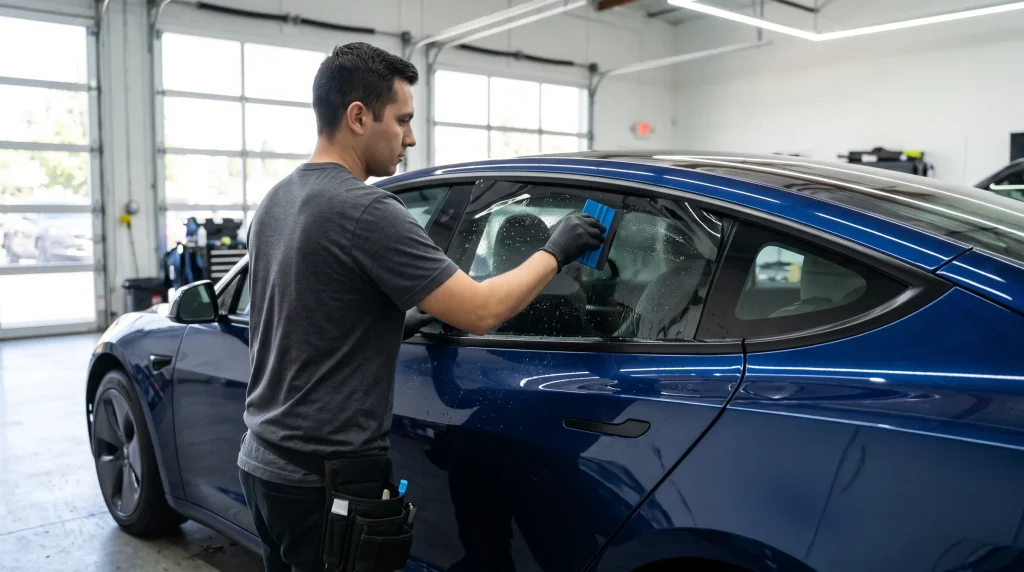
This is why asking for “20% all around” or “5% everywhere” can create a legal problem in California.
The window location matters.
Front Side Window Tint Rules in California
California’s front side window rules are often misunderstood.
You may hear people say that California simply allows “70% tint” on the front doors.
That description leaves out part of the law.
California Vehicle Code Section 26708 allows clear, colorless, and transparent material on the front side windows immediately to the left and right of the front seat when several conditions are met.
The law states that:
- The film itself must have a minimum Visible Light Transmittance of 88%
- The glass with the material installed must still meet the federal 70% minimum light-transmission requirement
- The material must be made to improve the existing glass’s ability to block UVA radiation
- The driver must keep a certificate from the installer or manufacturer in the vehicle
- Worn, torn, or bubbled material that interferes with clear vision must be removed or replaced
That is different from installing an ordinary dark 70% film on any front window and assuming the finished window automatically complies.
Here is why.
Factory automotive glass may already reduce some visible light before film is applied. Adding film changes the final amount of light passing through the glass.
For car window tinting in Folsom, CA, talk with your installer about the actual glass and California requirements before choosing film for the front doors.
Can You Tint the Windshield in California?
California places tight restrictions on windshield film because the windshield sits directly in the driver’s field of view.
Vehicle Code Section 26708 permits transparent material along the topmost portion of the windshield when the installation meets several conditions.
California does not describe this rule simply as a universal “top 4 inches” rule.
The law states that the bottom edge of the permitted material must be at least 29 inches above the undepressed driver’s seat, measured using the method listed in the statute.
The windshield material also:
- Cannot be red or amber
- Cannot contain opaque lettering
- Cannot distort primary colors or vision
- Cannot reflect sunlight or headlights toward other drivers more than the untreated windshield would
The California Highway Patrol states that aftermarket tinting is not allowed across the main windshield viewing area outside limited statutory exceptions.
What this means for Folsom drivers is simple: do not assume a full windshield tint is legal just because the film looks light.
Ask about California compliance before installing windshield film.
Rear Side Window and Back Window Tint Rules
California gives drivers much more freedom with windows behind the driver.
Vehicle Code Section 26708 specifically exempts side windows that are to the rear of the driver from the general restriction.
That means the rear passenger windows of many cars, SUVs, vans, and trucks can use darker film than the front side windows.
California also permits material on the rear window when the vehicle has outside mirrors on both the left and right sides that give the driver the required rearward view.
For many Folsom drivers, this makes rear-window tint a place where they can choose among several shades based on privacy, appearance, glare, and heat-control goals.
Royal Tint’s window tinting service displays common automotive film shades including:
- 5%
- 15%
- 20%
- 35%
- 50%
- 70%
Not every shade is legal on every window.
The film shade should be matched to the window location and California law.
What Does VLT Mean for Car Window Tint?
VLT stands for Visible Light Transmission.
It tells you how much visible light passes through a window or film.
The percentages work opposite from what some first-time tint buyers expect.
70% VLT
About 70% of visible light passes through.
This looks relatively light.
50% VLT
About half of visible light passes through.
35% VLT
The glass looks noticeably darker.
20% VLT
The window has a dark appearance.
5% VLT
Very little visible light passes through.
It is often called “limo tint.”
A lower number means darker tint.
VLT does not tell you everything about the film’s heat performance.
That distinction matters when shopping for car window tinting in Folsom, CA.
Why 70% Tint Does Not Always Mean 70% Final VLT
This is one of the easiest tint concepts to misunderstand.
Window glass can already have its own light-transmission value before aftermarket film is installed.
The final reading depends on the glass and film together.
Imagine a piece of factory glass that already allows less than 100% of visible light through it. Adding a film labeled with a certain VLT reduces the final transmission further.
That is why California Vehicle Code Section 26708 refers separately to the film’s minimum 88% VLT and the 70% minimum transmission for the glazing with the material applied when discussing the qualifying front-side UV film exception.
Do not choose front-window film based only on the number printed on a sample board.
The existing vehicle glass matters too.
California Medical Window Tint Exceptions
California law contains provisions for drivers and passengers with certain medical or visual conditions.
One provision allows qualifying sun-screening devices on the front side windows when the driver or front passenger carries documentation signed by a licensed physician and surgeon or optometrist.
Those removable devices cannot be used during darkness.
California Vehicle Code Section 26708 also contains a separate provision involving clear, colorless, and transparent material on the windshield, side, or rear windows for a qualifying medical condition involving UV exposure.
Under that provision:
- The material must have at least 88% VLT
- The glass and film must meet the federal 70% transmission requirement
- The material must be designed to block UVA rays
- The driver must carry documentation signed by a licensed dermatologist
- Damaged material that interferes with clear vision must be removed or replaced
Drivers seeking a medical exception should read the current California Vehicle Code and make sure they have the required documentation before relying on the exception.
Window Tint Film Options for Folsom Drivers
Once you know where film can legally be installed, the next question is what type of film you want.
Automotive tint technology has changed a lot from the simple dyed films many drivers remember.
Royal Tint installs Rayno Phantom Nano Carbon Ceramic window film.
Rayno’s Phantom Series combines nanoscale carbon and ceramic materials and is metal-free.
The current Phantom lineup includes several series and VLT levels, giving drivers choices in appearance and solar performance.
Darker Film Options
Darker films can provide:
- Greater privacy on windows where the shade is legal
- Lower visible-light transmission
- A darker exterior appearance
- Reduced visible glare
Lighter Film Options
Lighter films may appeal to drivers who:
- Prefer a less-dark appearance
- Want more nighttime visibility
- Want heat-control technology without very dark glass
- Need to work within California front-window requirements
Film quality matters as much as shade.
Why Ceramic Tint Can Make Sense in Folsom
Folsom summers can put vehicles under strong sunlight for hours at a time.
Drivers parking outdoors near work, shopping areas, schools, trails, or home may return to a vehicle that has absorbed solar energy through the glass.
Rayno’s Phantom Series uses Nano Carbon Ceramic technology designed to reject infrared energy and filter UV radiation.
Rayno’s current specifications show different infrared rejection figures depending on the Phantom series and shade.
The Phantom S9 line, as one example, lists infrared rejection above 90% across several published shades and 99.9% UV rejection in the manufacturer’s specifications.
Royal Tint’s car window tinting service highlights Rayno Phantom ceramic film for heat rejection, UV filtering, clarity, and long-term color stability.
For Folsom drivers, this can make ceramic tint attractive when heat control matters just as much as appearance.
Does Darker Tint Reject More Heat?
Not necessarily.
A darker-looking window is not automatically the best heat-rejecting window.
VLT tells you about visible light.
Infrared rejection and Total Solar Energy Rejected describe other parts of a film’s performance.
A lighter high-performance carbon ceramic film can offer strong infrared rejection without looking as dark as a low-VLT film.
Let’s break it down.
If your goal is privacy, shade matters a lot.
If your goal is solar heat reduction, ask about the film’s heat-related specifications.
If your goal is both, you need to consider shade and film technology together while staying within California law.
This is why car window tinting in Folsom, CA should not start with one question such as, “How dark can you make it?”
Ask what you want the film to do.
Choosing Tint for Cars, Trucks, SUVs, and Teslas
Different vehicles can come with different factory glass and window layouts.
Sedans and Coupes
Drivers may choose lighter front-side treatment where legally permitted and darker rear glass for privacy and glare control.
SUVs
Many SUVs already have factory privacy glass behind the driver.
Factory privacy glass and aftermarket film are not the same thing. Privacy glass may look dark while offering different heat and UV performance than an added film.
A ceramic film may still be installed on eligible rear glass when the owner wants additional solar-control properties.
Trucks
Crew-cab and extended-cab trucks often have large side glass areas. Film choice can help with glare and solar exposure for front and rear passengers.
Teslas and EVs
Vehicles with large glass areas can leave drivers asking more questions about heat rejection and visible-light levels.
Royal Tint also has a Tesla window tinting service featuring Rayno Nano Carbon Ceramic film.
No matter what you drive, the legal limit follows the window position rather than the price or type of vehicle.
Why Use a Professional Window Tint Installer?
Automotive window film has to fit moving glass, curved rear windows, defroster lines, window seals, and complex vehicle shapes.
Professional installation also gives you someone to ask about:
- Film series
- VLT
- California restrictions
- Heat rejection
- UV rejection
- Film warranty
- Drying time
- Cleaning
- Care after installation
Royal Tint is a Rayno Elite Dealer and uses certified installers.
Our current automotive window tint service includes a lifetime warranty on qualifying tint jobs as described by Royal Tint.
Rayno’s Phantom Series manufacturer warranty is also listed as a limited lifetime warranty under its published automotive warranty program.
Keep your invoice and warranty documentation after the work is complete.
Window Tinting Near Folsom, Sacramento, and Rancho Cordova
Royal Tint serves drivers from Folsom, CA, Sacramento, CA, Rocklin, CA & Rancho Cordova, CA, along with surrounding communities.
Royal Tint does not currently list a shop in Folsom. Our nearby Rancho Cordova location is:
Royal Tint Sacramento / Rancho Cordova
3515 Sunrise Blvd Suite #21
Rancho Cordova, CA 95742
(916) 502-2994
Our second location is:
Royal Tint Rocklin
5600 Pacific St Suite 100
Rocklin, CA 95677
(916) 840-0030
Drivers also visit Royal Tint from Fair Oaks, CA, Orangevale, CA, Carmichael, CA, Citrus Heights, CA, Roseville, CA, Granite Bay, CA, Loomis, CA, Lincoln, CA, Elk Grove, CA, and El Dorado Hills, CA.
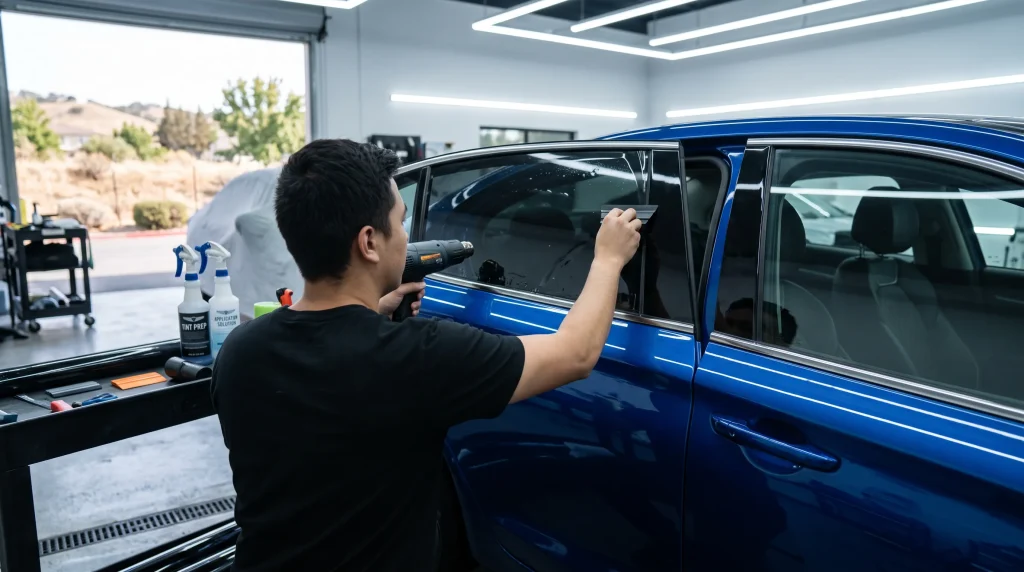
For many Folsom drivers, our Rancho Cordova location provides a nearby option via the Highway 50 corridor.
See both shops on the Royal Tint locations page.
Why Choose Royal Tint for Car Window Tinting Near Folsom?
Royal Tint has served the Sacramento region since 2016.
We are a Rayno Elite Dealer and install Rayno Nano Carbon Ceramic window film.
Royal Tint also provides:
- Window tinting
- Paint Protection Film
- Ceramic coating
- Tesla window tinting
- Windshield protection film
- Auto detailing
- Paint correction
Royal Tint has more than 700 combined customer reviews with a 5-star rating based on the business review information provided by Royal Tint.
When choosing car window tinting in Folsom, CA, tell us what you want from the film.
Do you care most about heat?
Privacy?
Glare?
UV filtering?
Appearance?
Nighttime visibility?
Our team can show you Rayno film options and discuss which windows can receive the shade you are considering.
Call (916) 502-2994 for Rancho Cordova or (916) 840-0030 for Rocklin.
You can also contact Royal Tint online to schedule an appointment.
Car Window Tinting FAQs
1. What is the legal window tint limit in California?
California treats different vehicle windows differently. For the front side windows, the statutory clear-film exception requires film with at least 88% VLT, while the finished glass-and-film combination must meet the federal 70% light-transmission requirement. Side windows behind the driver are exempt from the general restriction, while a tinted rear window requires qualifying outside mirrors on both sides.
2. Can I put 35% tint on my front windows in California?
Ordinary 35% aftermarket tint on the front driver and passenger windows does not meet the clear, colorless front-side material exception described in California Vehicle Code Section 26708. That exception requires qualifying material with at least 88% VLT and a finished glazing system meeting the federal 70% minimum.
3. Can I use 5% tint on my rear windows in California?
California Vehicle Code Section 26708 provides an exception for side windows behind the driver. Rear-window film is also permitted when the vehicle has qualifying outside mirrors on both sides. Drivers should still make sure the installation does not create another equipment or visibility issue.
4. Can I tint my entire windshield in California?
Ordinary dark film across the main windshield viewing area is restricted. California permits qualifying material along the top portion of the windshield when it meets the placement, color, lettering, and reflectivity requirements in Vehicle Code Section 26708. The law also contains a separate provision for qualifying clear material associated with certain medical conditions.
5. Is ceramic window tint legal in California?
Ceramic technology itself is not what determines whether an installation meets the tint rules. Window position, film transparency, combined VLT, and other statutory conditions matter. A ceramic film may be suitable for one window while a darker version of that same film may not be suitable for a restricted front window.
6. Does ceramic tint reject more heat than regular dark tint?
It can. Film darkness and heat rejection are separate measurements. Rayno’s Phantom Nano Carbon Ceramic films are made to reject infrared energy while filtering 99.9% of UV radiation in the manufacturer’s published specifications. Compare the exact film series and shade rather than judging heat performance only by darkness.
7. Where can I get car window tinting near Folsom, CA?
Royal Tint serves Folsom drivers from our nearby Rancho Cordova shop at 3515 Sunrise Blvd Suite #21, Rancho Cordova, CA 95742. Call (916) 502-2994 for Rancho Cordova or (916) 840-0030 for Rocklin. You can also contact Royal Tint online to schedule your tint appointment.
Choose Your Tint Based on the Law and the Film
Car window tinting in Folsom, CA can change the way your vehicle looks and feels, but the darkest option is not automatically the right one.
California law gives the front windows different treatment from the glass behind the driver.
VLT matters.
The existing factory glass matters.
Film technology matters.
Heat rejection matters.
Visibility matters.
The window receiving the film matters.
Start by deciding what you want from your tint, then choose a film and shade that fit your vehicle and the applicable California rules.
Royal Tint installs Rayno Nano Carbon Ceramic window film for drivers from Folsom, CA, Sacramento, CA, Rocklin, CA & Rancho Cordova, CA.
Call (916) 502-2994 for our Rancho Cordova location or (916) 840-0030 for our Rocklin location.
You can also contact Royal Tint online to schedule an appointment and compare film options.
Sources
- California Vehicle Code Section 26708
Publisher: California Legislative Information
Publication Date: Current section amended by Stats. 2025, Ch. 417, effective January 1, 2026
Used for: Front side window VLT requirements, rear side window exception, rear-window mirror requirement, windshield strip rules, installer certification paperwork, and medical provisions. - California Highway Patrol FAQ
Publisher: California Highway Patrol
Publication Date: Current webpage
Used for: CHP guidance on aftermarket tinting, front windows, windshield restrictions, rear-window tint, and dual outside mirrors. - Phantom Series Automotive Window Film
Publisher: Rayno Window Film
Publication Date: Current product page
Used for: Nano Carbon Ceramic film construction, available VLT levels, infrared rejection, UV rejection, TSER, color stability, and film specifications. - Royal Tint Window Tinting
Publisher: Royal Tint
Publication Date: Website page
Used for: Rayno Phantom Series, available tint shades, Nano Carbon Ceramic technology, heat rejection, UV filtering, warranty information, and Royal Tint service details. - Royal Tint Tesla Window Tinting
Publisher: Royal Tint
Publication Date: Website page
Used for: Tesla tint options, Rayno film information, available shades, location addresses, and phone numbers. - About Royal Tint
Publisher: Royal Tint
Publication Date: Website page
Used for: Rayno Elite Dealer status, certified installer information, business history, locations, and contact information. - Royal Tint Locations
Publisher: Royal Tint
Publication Date: Website page
Used for: Rancho Cordova and Rocklin shop information and service-area linking.