
Paint correction in Folsom, CA can restore clarity and gloss when swirl marks, oxidation, water spots, haze, wash scratches, and other surface defects start hiding the true finish of your vehicle. When the paint needs more than a light polish, a multi-stage correction uses separate cutting and refining steps to address heavier defects while leaving the surface clearer and glossier.
The phrase “multi-stage polish” can sound complicated, but the idea is straightforward. A stronger polishing stage tackles the more visible defects first. A finer polishing stage follows to refine the surface, remove haze from the earlier step, and bring out a cleaner reflection.
Royal Tint provides 1-step and 2-step paint correction for drivers from Folsom, CA, Sacramento, CA, Rocklin, CA & Rancho Cordova, CA. Our Rancho Cordova location at 3515 Sunrise Blvd Suite #21, Rancho Cordova, CA 95742 is nearby for drivers coming from Folsom along the Highway 50 corridor.
If your paint looks swirled, dull, hazy, scratched, or oxidized, call (916) 502-2994 for Rancho Cordova or (916) 840-0030 for Rocklin. You can also contact Royal Tint online to schedule an appointment.
Table of Contents
- What Is Multi-Stage Paint Correction?
- What Defects Can Paint Correction Address?
- Stage 1: Vehicle Wash and Paint Inspection
- Stage 2: Paint Decontamination and Clay Treatment
- Stage 3: Cutting and Compounding
- Stage 4: Refining and Finishing Polish
- Stage 5: Final Paint Inspection
- 1-Step vs 2-Step Paint Correction
- Can Multi-Stage Polishing Remove Deep Scratches?
- Why Dark Paint Often Benefits From a Finishing Stage
- Should New Cars Get Paint Correction?
- Paint Correction Before Ceramic Coating
- Paint Correction Before Paint Protection Film
- How to Keep Corrected Paint Looking Good
- Paint Correction Near Folsom, CA
- Paint Correction FAQs
What Is Multi-Stage Paint Correction?
Multi-stage paint correction uses more than one machine-polishing step to work on automotive paint.
Royal Tint offers paint correction and detailing with both 1-step and 2-step correction options.
A 1-step service uses one polishing stage to address lighter defects while adding gloss.
A 2-step service separates the job into two polishing stages.
The first stage is usually more aggressive. It focuses on defect removal.
The second stage uses a finer polishing combination to refine the finish.
A multi-stage process may make sense when paint has:
- Heavy swirl marks
- Oxidation
- Wash scratches
- Polishing haze
- Water-spot etching
- Fine scratches
- Dull reflections
- Compound marks
- Holograms
Paint correction in Folsom, CA should start with the condition of the vehicle rather than automatically choosing the longest polishing process.
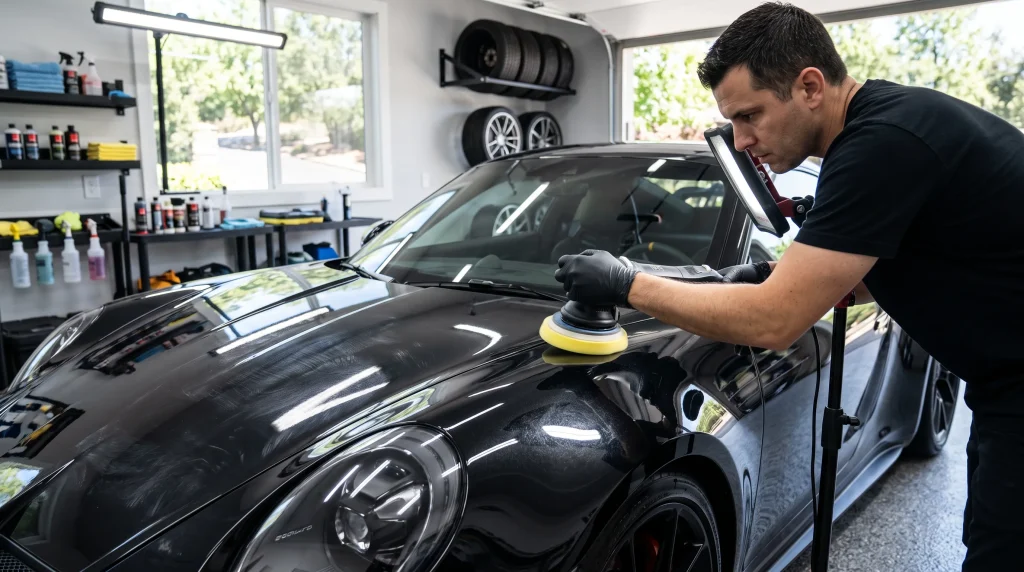
If a car only has light marks, one stage may be enough.
If the paint has years of washing damage, a second stage may produce a cleaner finish.
What Defects Can Paint Correction Address?
Machine polishing can address many surface defects when they remain within a safe polishing depth.
3M states that automotive machine polish can remove or reduce swirl marks, minor scratches, water spots, compound marks, and light oxidation.
Paint correction in Folsom, CA may help with several common issues.
Swirl Marks
Swirls are fine scratches that often become easy to see under sunlight.
They can come from:
- Automatic brush washes
- Dirty wash mitts
- Dry wiping
- Dirty drying towels
- Poor polishing methods
- Repeated contact with dusty paint
Light Scratches
Some fine scratches remain within the upper clear-coat surface and can be reduced through polishing.
Deeper scratches may not be safe to remove completely.
Oxidation
Light oxidation can make paint appear faded, cloudy, chalky, or dull.
Polishing may remove the damaged surface layer when enough healthy paint remains.
Water Spots
Mineral deposits can sit on the paint or etch into it.
Some respond to cleaning alone.
Others may need polishing.
Haze
Fine scratches and poor previous polishing can leave paint looking cloudy instead of reflective.
Holograms
Rotary polishing or aggressive compounding can leave visible machine trails, especially on dark paint.
A finer finishing stage can help remove these marks.
Stage 1: Vehicle Wash and Paint Inspection
Paint correction in Folsom, CA starts before a polishing machine touches the vehicle.
The car needs to be washed and inspected.
Loose dirt, dust, pollen, bugs, and road film should be removed first so the technician can see the paint more clearly.
The inspection looks for:
- Swirls
- Scratches
- Oxidation
- Water spots
- Haze
- Paint chips
- Previous repairs
- Repainted panels
- Clear-coat failure
- Areas requiring extra care
Not every panel on a vehicle is necessarily in the same condition.
A hood may have heavy water spotting.
The doors may show wash swirls.
The roof may have oxidation.
One fender may have been repainted after body work.
These differences affect how the polishing work should be approached.
Paint correction is not about attacking every panel with the strongest compound available.
The goal is to remove or reduce defects while preserving healthy paint.
Stage 2: Paint Decontamination and Clay Treatment
Washing removes loose contamination, but some material can remain bonded to the paint.
Run your hand over a freshly washed vehicle and the surface may still feel rough.
That roughness can come from material such as:
- Road fallout
- Tar
- Tree residue
- Embedded dirt
- Brake-related contamination
- Fine particles bonded to the surface
Royal Tint lists clay-bar treatment as part of its paint correction process.
Clay treatment removes bonded material that normal washing may leave behind.
This step matters before machine polishing.
A polishing pad should work against clean paint rather than dragging trapped contamination around the panel.
Once the surface is decontaminated, the technician can get a clearer view of the actual scratches, swirls, oxidation, and paint texture.
Stage 3: Cutting and Compounding
The cutting stage is where a 2-step correction begins to differ from a lighter 1-step polish.
Cutting uses a compound and pad combination selected to remove more noticeable defects.
The abrasive action works on the upper paint or clear-coat surface, reducing the uneven areas that create visible scratches and swirls.
This stage may address:
- Heavy swirl marks
- More noticeable wash scratches
- Oxidation
- Etching
- Deeper haze
- Previous polishing marks
The compound, pad, machine, speed, pressure, and number of polishing passes can all affect how much correction occurs.
Paint type matters too.
Some clear coats respond quickly to polishing.
Others may need a different pad or abrasive combination.
Here’s what matters.
More cutting is not always better.
Every time a technician removes a defect through polishing, a tiny amount of the painted surface is being refined.
The goal should be enough correction to get a strong visual result without chasing defects that are too deep to remove safely.
Stage 4: Refining and Finishing Polish
After the cutting stage, the paint may look much better but still need refinement.
A stronger compound can leave behind:
- Fine haze
- Compound marks
- Micro-scratches
- Machine-polishing trails
The finishing stage uses a finer polish and softer polishing combination to refine those marks.
3M describes its machine polish as a product designed to remove compound swirls while leaving a smooth, high-gloss finish. Its Perfect-It EX finishing products are also made to refine paint after heavier compounding.
This second polishing stage is one reason 2-step paint correction can look cleaner than stopping after a heavy cutting pass.
Paint correction in Folsom, CA on dark vehicles can benefit greatly from careful finishing.
Black paint is especially unforgiving.
A panel may look clear under indoor lighting but reveal haze or machine trails once it is moved into sunlight.
The final polish is aimed at making the reflection look cleaner rather than simply removing more material.
Stage 5: Final Paint Inspection
Once polishing is finished, the paint should be inspected again.
The technician checks the corrected areas under lighting that makes remaining defects easier to see.
This review may look for:
- Remaining swirls
- Haze
- Holograms
- Compound residue
- Missed areas
- Polish around trim
- Deep defects that were intentionally left
- Overall gloss and clarity
No responsible paint correction process should promise that every scratch will disappear.
Some defects may be too deep.
Trying to remove them completely could require taking away more clear coat than makes sense.
A strong correction result may mean greatly reducing a defect rather than chasing complete removal.
1-Step vs 2-Step Paint Correction
Drivers looking for paint correction in Folsom, CA often ask whether they need one or two stages.
The answer depends on the paint.
1-Step Paint Correction
Royal Tint describes its 1-step correction as a process for lighter imperfections and swirl marks.
It may fit a vehicle with:
- Light swirling
- Fine wash marks
- Mild haze
- Minor paint defects
- Relatively healthy clear coat
One polishing stage is used to balance defect reduction with gloss.
2-Step Paint Correction
Royal Tint describes its 2-step correction as the option for deeper imperfections, more severe scratches, and oxidation.
A typical 2-step structure involves:
First stage: stronger cutting or compounding.
Second stage: finer polishing and surface refinement.
A 2-step correction may fit:
- Dark cars with heavy swirls
- Vehicles that have used brush washes for years
- Oxidized finishes
- Cars with noticeable haze
- Paint with moderate wash damage
- Vehicles preparing for ceramic coating after heavier correction
The number of stages should match the paint.
A lightly marked vehicle does not need aggressive correction just because two stages sound more thorough.
Can Multi-Stage Polishing Remove Deep Scratches?
Sometimes paint correction can make a scratch much harder to see.
That does not mean every scratch can safely disappear.
A scratch may sit:
- In the upper clear coat
- Deeper in the clear coat
- Into the color layer
- Into primer
- Down to metal or plastic
Machine polishing can work on defects that remain within a safe polishing range.
It cannot replace missing paint.
If a scratch has gone through the clear coat or color layer, removing enough surrounding material to level it may not be safe.
In that case, the better result may be reducing its appearance.
Paint correction in Folsom, CA should protect the remaining finish rather than sacrificing too much clear coat for one mark.
Why Dark Paint Often Benefits From a Finishing Stage
Black paint can look incredible when polished well.
It can also reveal polishing mistakes quickly.
Direct sunlight may show:
- Swirls
- Haze
- Holograms
- Fine scratches
- Towel marks
The same defects can be harder to notice on lighter colors.
This makes finishing work especially noticeable on black, dark blue, dark gray, and deep red vehicles.
3M makes several finishing polishes around removing swirl marks after compounding, including products aimed at dark-colored automotive finishes.
A multi-stage correction can use the first step to handle stronger defects and the next step to clean up the visual finish.
The result is a sharper reflection and less haze under bright light.
Should New Cars Get Paint Correction?
New cars do not automatically need paint correction.
They should still be inspected.
Before delivery, a new vehicle may experience:
- Transportation
- Outdoor storage
- Dealer washing
- Water spotting
- Dust
- Protective-film removal
- Dry wiping
- Repeated handling
Some vehicles arrive with very clean paint.
Others already have fine wash marks or light scratches.
Paint correction in Folsom, CA for a new car may involve only a light polish if defects are minor.
There is no reason to remove clear coat from paint that already looks clean.
Inspect first.
Then choose the amount of correction based on what is actually visible.
Paint Correction Before Ceramic Coating
Ceramic coating is transparent.
If swirl marks or haze are visible before the coating is installed, they may remain visible underneath it afterward.
That is why paint correction often comes before coating.
Royal Tint installs BLASK ceramic coating after the surface has been prepared for the selected coating system.
A typical service order may include:
- Wash
- Decontamination
- Paint inspection
- Paint correction when needed
- Finishing polish
- Surface cleaning
- Ceramic coating application
- Cure period
Royal Tint offers BLASK RX711, RX520, and RX752 paint coatings.
Ceramic coating can add:
- Gloss
- Slickness
- Hydrophobic water behavior
- Chemical resistance
- Easier washing
- Resistance against common environmental contamination
It should go over paint that has been prepared to the level the owner wants to preserve.
Paint Correction Before Paint Protection Film
Paint Protection Film is also transparent.
A clear PPF can protect the surface underneath while still allowing visible paint defects to show.
If a hood has swirl marks and those marks bother you, correcting them before film installation may make sense.
Royal Tint installs Onyxhield Paint Protection Film for vehicles that need physical protection against road debris, chips, and surface contact.
Correction and PPF perform separate jobs.
Paint correction works on defects already in the paint.
PPF places a physical film over the corrected surface.
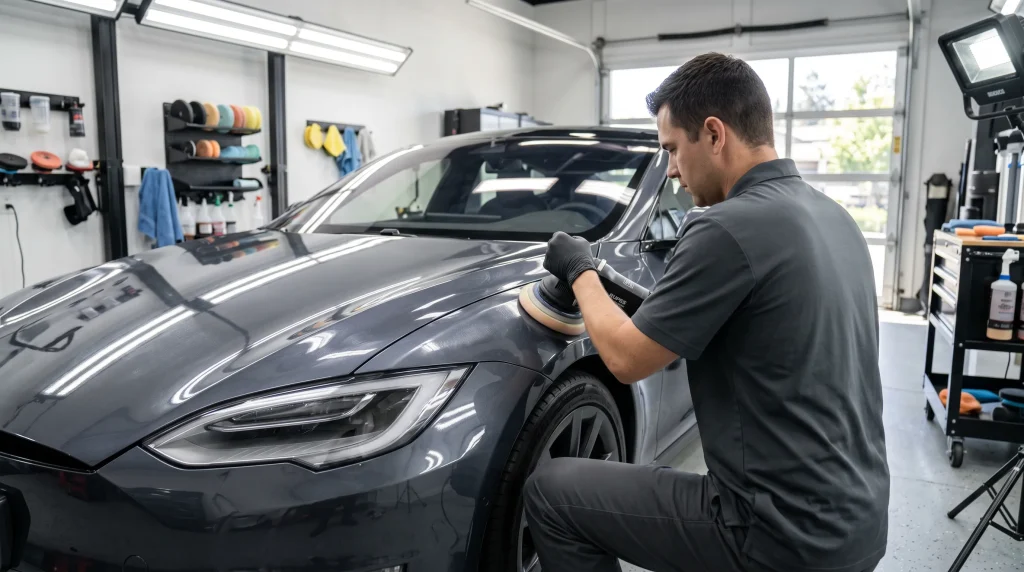
For Folsom drivers regularly using Highway 50, combining a cleaned-up finish with PPF on high-impact areas can be worth discussing.
How to Keep Corrected Paint Looking Good
Paint correction removes old defects.
It cannot stop new defects from forming if the vehicle goes back to the same washing habits.
Avoid Brush-Style Automatic Car Washes
Repeated brush contact can create fine scratches.
Do Not Wipe Dry Dust From Paint
Rubbing a towel across dusty paint can drag particles over the finish.
Use Clean Wash Mitts
Grit trapped in wash materials can scratch paint.
Use Clean Drying Towels
Drying puts a lot of contact on the finish.
Remove Bugs Carefully
Do not scrub dried bug residue aggressively.
Deal With Bird Droppings Early
Clean contamination before it sits for long periods.
Consider Ceramic Coating
A slick surface can make dirt easier to remove during washing.
Consider PPF for High-Impact Areas
PPF can add a physical barrier where road debris is a bigger concern.
Paint correction in Folsom, CA gives you the clean starting point.
Your wash habits help determine how long that polished appearance stays clean.
Paint Correction Near Folsom, CA
Royal Tint serves drivers from Folsom, CA, Sacramento, CA, Rocklin, CA & Rancho Cordova, CA.
For many Folsom drivers, our Rancho Cordova shop is nearby along Highway 50:
Royal Tint Sacramento / Rancho Cordova
3515 Sunrise Blvd Suite #21
Rancho Cordova, CA 95742
(916) 502-2994
Our second location is:
Royal Tint Rocklin
5600 Pacific St Suite 100
Rocklin, CA 95677
(916) 840-0030
Royal Tint also serves drivers from Fair Oaks, CA, Orangevale, CA, Citrus Heights, CA, Carmichael, CA, El Dorado Hills, CA, Roseville, CA, Granite Bay, CA, Loomis, CA, Lincoln, CA, Elk Grove, CA, and Antelope, CA.
Our services include:
- Paint correction and detailing
- Ceramic coating
- Paint Protection Film
- Window tinting
- Windshield protection film
Royal Tint is certified by Rayno, Onyxhield, and BLASK and works with these brands as a vendor.
Based on the business information supplied by Royal Tint, our two locations have more than 700 combined customer reviews with a 5-star rating.
If your paint needs more than a quick polish, call (916) 502-2994 for Rancho Cordova or (916) 840-0030 for Rocklin.
You can also contact Royal Tint online to schedule an inspection.
Paint Correction FAQs
1. What does multi-stage paint correction include?
A multi-stage paint correction commonly starts with washing, paint inspection, and decontamination. A stronger cutting or compounding stage is then used to address heavier defects. A finer polishing stage follows to reduce haze and compound marks while restoring gloss and clarity. The paint is inspected again after polishing.
2. What is the difference between 1-step and 2-step paint correction?
A 1-step correction uses one polishing stage and is generally suited to lighter swirls and minor imperfections. A 2-step correction uses a stronger defect-removal stage followed by a finer polishing stage. Royal Tint recommends its 2-step process for paint with deeper imperfections, more severe scratches, or oxidation.
3. Can multi-stage polishing remove oxidation?
Light to moderate oxidation may respond to machine correction when enough healthy paint remains. 3M lists light oxidation among the surface defects its automotive machine polish can remove. Peeling or failed clear coat cannot be repaired through polishing alone.
4. Can paint correction remove every swirl mark?
Royal Tint states that its paint correction process can reduce up to 90% of swirl marks depending on the vehicle and paint condition. Some marks may be too deep to remove safely, so complete removal should not be assumed before the paint is inspected.
5. Should I get paint correction before ceramic coating?
If swirl marks, haze, water spots, or light scratches are visible and you want them reduced, correction should usually happen before coating. Ceramic coating is transparent and does not erase defects underneath it.
6. Should paint correction come before PPF?
When visible defects are present on a panel that will receive clear Paint Protection Film, polishing first can give the covered surface a cleaner appearance. Royal Tint can inspect the paint before installing Onyxhield PPF.
7. Where can I get paint correction near Folsom, CA?
Royal Tint provides paint correction at 3515 Sunrise Blvd Suite #21, Rancho Cordova, CA 95742, near Folsom along the Highway 50 corridor. Call (916) 502-2994 for Rancho Cordova or (916) 840-0030 for Rocklin. You can also contact Royal Tint online.
Give Heavily Swirled Paint More Than a Quick Polish
Paint correction in Folsom, CA can range from a lighter one-stage polish to a multi-stage process for paint that needs more defect removal.
The first polishing stage does the heavier cutting.
The second stage refines the finish.
Wash and decontamination come before both.
Inspection comes before and after the polishing work.
Not every vehicle needs two stages, and not every scratch should be chased until it disappears.
The right correction level depends on the actual paint condition.
If you want to protect the polished finish afterward, Royal Tint can also discuss BLASK ceramic coating or Onyxhield Paint Protection Film.
Royal Tint serves drivers throughout Folsom, CA, Sacramento, CA, Rocklin, CA & Rancho Cordova, CA.
Call (916) 502-2994 for our Rancho Cordova shop or (916) 840-0030 for Rocklin.
You can also contact Royal Tint online to schedule paint correction and find out whether your vehicle needs a 1-step or 2-step polishing process.
Sources
- Royal Tint Paint Correction / Restoration
Publisher: Royal Tint
Publication Date: Website page
Used for: 1-step and 2-step paint correction, clay-bar treatment, buffing, polishing, swirl reduction, oxidation correction, locations, and phone numbers. - Ceramic Coating in Folsom, CA: Packages, Pricing & What’s Included
Publisher: Royal Tint
Publication Date: Website article
Used for: Folsom service-area information, paint inspection, decontamination, one-step and two-step correction, paint correction before ceramic coating, and local driving context. - 3M Finesse-it II Machine Polish
Publisher: 3M
Publication Date: No publication date listed
Used for: Machine polishing, swirl removal, light scratches, water spots, light oxidation, clear-coat polishing, and high-gloss finishing. - 3M Machine Polish
Publisher: 3M
Publication Date: No publication date listed
Used for: Compound-swirl removal, car-wash scratches, minor paint defects, dark-colored vehicle finishes, and clear-coat-safe polishing. - 3M Perfect-It EX Machine Polish
Publisher: 3M
Publication Date: No publication date listed
Used for: Refining automotive paint after compounding and removing swirl marks left by a stronger cutting stage. - 3M Perfect-It EX Ultrafine Machine Polish
Publisher: 3M
Publication Date: No publication date listed
Used for: Final-stage refinement, ultrafine swirl removal, and finishing dark-colored automotive paint. - Royal Tint Ceramic Coating
Publisher: Royal Tint
Publication Date: Website page
Used for: BLASK ceramic coating options, coating after paint preparation, Rancho Cordova location, and Rocklin location. - Royal Tint Paint Protection Film
Publisher: Royal Tint
Publication Date: Website page
Used for: Onyxhield PPF services and internal linking for physical paint protection after correction. - Contact Royal Tint
Publisher: Royal Tint
Publication Date: Website page
Used for: Appointment and contact information.