
Window tinting in Auburn, CA can help drivers deal with hot summer sun, glare, UV exposure, and heat entering through vehicle glass. Auburn’s foothill location also means drivers may spend plenty of time traveling I-80 between Placer County, Rocklin, Roseville, and Sacramento, where long periods behind glass can make solar heat and glare much more noticeable.
Choosing window tint in California takes more than picking the darkest shade on a sample board.
California places different rules on front side windows, rear side windows, the back glass, and the windshield. The type of film matters too. A modern carbon ceramic film can reject high levels of infrared energy without requiring the darkest appearance available.
Royal Tint installs Rayno Nano Carbon Ceramic window film for drivers throughout Auburn, CA, Sacramento, CA, Rocklin, CA & Rancho Cordova, CA. Our Rocklin location at 5600 Pacific St Suite 100, Rocklin, CA 95677 serves drivers coming from Auburn and other Placer County communities.
Call (916) 840-0030 for Rocklin or (916) 502-2994 for Rancho Cordova. You can also contact Royal Tint online to schedule your vehicle.
Table of Contents
- Why Auburn Drivers Get Window Tint
- California Window Tint Laws
- Front Side Window Tint Rules
- Rear Side Window and Back Glass Rules
- California Windshield Tint Rules
- What VLT Means
- Why Film VLT and Final Window VLT Are Different
- Rayno Ceramic Tint Options
- Does Darker Tint Reject More Heat?
- Why Ceramic Tint Makes Sense for Foothill Heat
- Window Tint and UV Exposure
- Glare and Auburn Driving
- Factory Privacy Glass vs Window Film
- Choosing Tint for Cars Trucks SUVs and EVs
- Window Tinting Near Auburn, CA
- Window Tinting FAQs
Why Auburn Drivers Get Window Tint
Auburn sits along the I-80 corridor in the Sierra foothills.
Drivers heading between Auburn, Newcastle, Loomis, Rocklin, Roseville, and Sacramento may spend long stretches with sunlight entering through the windshield and side glass.
Summer heat across the Sacramento region can be intense. National Weather Service Sacramento climate data for July 2026 recorded an average daily high of more than 93 degrees at Sacramento Executive Airport, with 25 days reaching at least 90 degrees.
A parked vehicle can feel much hotter than the outdoor air once solar energy passes through the glass and heats seats, dashboards, door panels, and other cabin surfaces.
Window tinting in Auburn, CA can help by reducing part of that solar energy before it reaches the interior.
Drivers also choose tint for:
- Glare reduction
- UV filtering
- Rear-seat comfort
- Privacy
- Interior protection
- A darker exterior appearance
- Better comfort during long drives
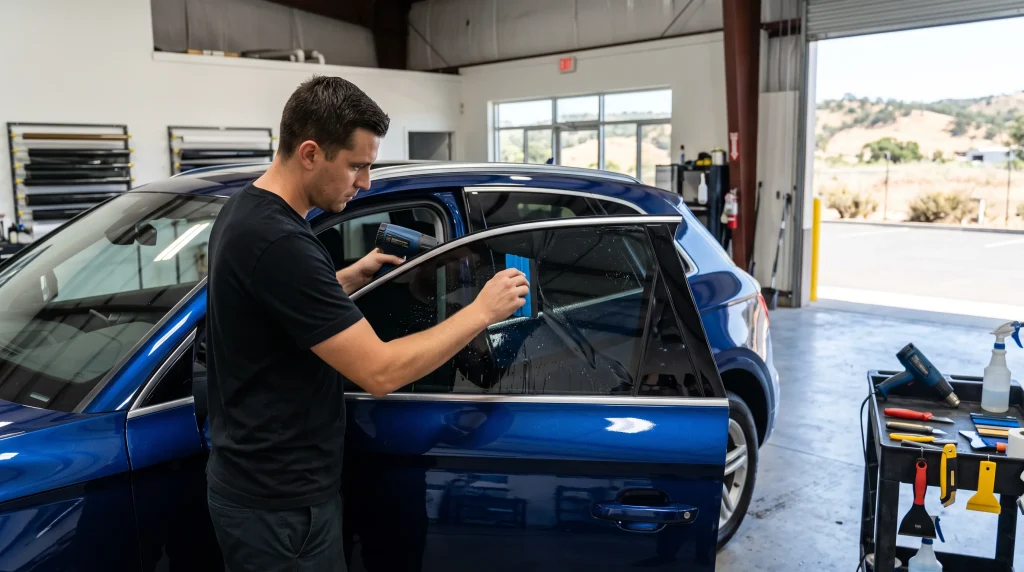
The right film depends on which windows you want tinted and what you want the film to do.
California Window Tint Laws
California Vehicle Code Section 26708 governs many of the rules drivers need to know before installing aftermarket window film.
The law starts with a general restriction against materials placed on vehicle windows when they obstruct or reduce the driver’s clear view. It then lists several exceptions.
Here is a simple breakdown.
| Window | General California Rule |
|---|---|
| Front driver-side window | Ordinary dark aftermarket tint is restricted. Qualifying clear, colorless UV material has separate requirements. |
| Front passenger-side window | Same general rule as the driver-side front window. |
| Rear side windows | Windows behind the driver are exempt from the general restriction. |
| Rear window | Tint is allowed when qualifying outside mirrors are installed on both sides. |
| Windshield | Ordinary full-windshield dark tint is restricted. A qualifying upper strip is allowed under specific rules. |
The current version of Section 26708 was amended effective January 1, 2026.
This is why legal window tinting in Auburn, CA should be planned by window position instead of choosing one shade for every piece of glass.
Front Side Window Tint Rules
California’s front side window rule is often described too loosely.
You may hear that “70% is legal on the fronts.”
The actual statute is more specific.
California Vehicle Code Section 26708 allows clear, colorless, and transparent material on the side windows immediately to the left and right of the front seat when certain conditions are met.
The statute says:
- The material must have at least 88% Visible Light Transmittance
- The glass with the film installed must meet the federal 70% minimum light-transmission requirement
- The material must be made to improve the existing glass’s ability to block UVA rays
- The driver must carry the required certificate identifying the installer or manufacturer
- Film that becomes torn, bubbled, or worn enough to interfere with clear vision must be removed or replaced
This is not the same as installing an ordinary dark 70% film on a front side window.
The glass underneath already affects how much light passes through the finished window.
For legal window tinting in Auburn, CA, the existing glass and film need to be considered together.
Rear Side Window and Back Glass Rules
California gives drivers much more freedom on windows behind the driver.
Vehicle Code Section 26708 lists side windows to the rear of the driver as an exception to the general restriction.
That means many cars, trucks, SUVs, and vans can use darker film on the rear side windows than on the front side glass.
The rear window also has an exception when the vehicle has outside mirrors on both the left and right sides that provide the required rearward view.
This gives drivers more shade choices for areas such as:
- Rear passenger windows
- Cargo-area side glass
- Back glass
Royal Tint’s window tint options include several VLT levels, depending on the Rayno film selected.
Not every shade belongs on every window.
A 15% or 20% rear film may be allowed where a similar film on the driver’s front side window would not fit California’s front-window rule.
California Windshield Tint Rules
California does not allow ordinary dark tint over the main windshield viewing area.
Vehicle Code Section 26708 does permit transparent material along the topmost portion of the windshield when it meets specific placement and material requirements.
The statute says the bottom edge must sit at least 29 inches above the undepressed driver’s seat, measured using the method written into the law.
The windshield strip also cannot:
- Be red
- Be amber
- Have opaque lettering
- Distort primary colors or vision
- Reflect sunlight or headlight glare toward other drivers beyond the untreated windshield level
The California Highway Patrol also warns that aftermarket tinting is generally prohibited across the windshield and front side windows outside the exceptions provided by law.
If windshield heat is your concern, ask Royal Tint what California-compliant choices may fit your vehicle rather than assuming a light-looking windshield film is automatically allowed.
What VLT Means
VLT stands for Visible Light Transmittance.
It measures how much visible light passes through the film or window.
Lower numbers mean darker glass.
70% VLT
A large amount of visible light passes through.
The appearance is relatively light.
50% VLT
About half of visible light passes through.
35% VLT
The glass looks noticeably darker.
20% VLT
The window has a dark appearance.
15% VLT
The glass is darker again and offers more visual privacy.
5% VLT
Very little visible light passes through.
This is often referred to as limo tint.
VLT measures visible light.
It does not tell you the full story about heat rejection.
Why Film VLT and Final Window VLT Are Different
Factory vehicle glass does not necessarily start at 100% light transmission.
That matters when film is installed.
The existing glass and aftermarket film work together to determine the finished window’s light transmission.
This is one reason California law separately states that qualifying front-side film must have at least 88% VLT while the finished glass and film combination must meet the federal 70% transmission requirement.
A film sample labeled with one percentage does not guarantee the finished glass will measure exactly that number.
For window tinting in Auburn, CA, drivers should not choose front-side film based only on a sample card.
The factory glass needs to be part of the discussion.
Rayno Ceramic Tint Options
Royal Tint is a Rayno Elite Dealer and installs Rayno Nano Carbon Ceramic automotive window film.
Rayno’s current Phantom Series includes several product levels and shades.
Phantom S5
Current Rayno specifications list Phantom S5 shades from 5% through 50% VLT.
Depending on shade, the current product table lists infrared rejection from roughly 53% to 72%, with 99.9% UV rejection.
Phantom S7
Phantom S7 uses Rayno’s carbon ceramic film construction with stronger infrared rejection than the S5 range in several shades.
Current published specifications list infrared rejection between roughly 70% and 81% across many S7 shade choices, with 99.9% UV rejection.
Phantom S9
Phantom S9 sits at the higher end of the current Phantom lineup.
Rayno’s current published specifications list 91% to 93% infrared rejection across many S9 shades and 99.9% UV rejection.
Phantom II
Rayno also offers Phantom II Nano Carbon Ceramic film.
The manufacturer currently states that Phantom II can reject up to 97% of infrared energy and 99.9% of UV rays, depending on the film configuration.
Ask Royal Tint which current Rayno series and shades are available for your vehicle.
Learn more on Royal Tint’s window tinting page.
Does Darker Tint Reject More Heat?
Not always.
This is one of the biggest misconceptions about window tinting in Auburn, CA.
A very dark film may block more visible light, but darkness alone does not tell you how well the film handles infrared energy or total solar energy.
Look at Rayno’s current Phantom S9 specifications.
Several shades from 5% through 50% VLT all list infrared rejection in the low 90% range.
That means a lighter high-performance film can reject a large amount of infrared energy without being the darkest shade in the lineup.
Here is why.
VLT measures visible light.
Infrared rejection measures performance against infrared energy in the tested range.
TSER measures Total Solar Energy Rejected.
Those are different measurements.
If your goal is reducing heat, do not shop based only on darkness.
Why Ceramic Tint Makes Sense for Foothill Heat
Auburn drivers can experience long periods of bright sunlight during summer driving.
A good ceramic film can help manage the solar energy entering through vehicle glass.
Rayno’s Phantom products combine nanoscale carbon and ceramic materials in a metal-free film.
Depending on the series, Rayno publishes benefits involving:
- Infrared rejection
- UV rejection
- Color stability
- Optical clarity
- Solar heat control
This can be useful when driving:
- I-80
- Highway 49
- Auburn Folsom Road
- Lincoln Way
- Bell Road
- Routes toward Rocklin and Roseville
Window tint cannot stop the vehicle from warming when parked outside for hours.
It can reduce part of the solar energy passing through the treated glass.
Window Tint and UV Exposure
UV filtering is another reason drivers consider ceramic tint.
Rayno’s current Phantom S5, S7, and S9 specifications list 99.9% UV rejection.
Phantom II also lists 99.9% UV rejection.
This can help reduce UV exposure entering through treated glass and can also support interior care.
Vehicle interiors can include:
- Leather
- Vinyl
- Plastics
- Dash materials
- Trim
- Upholstery
Sun exposure happens gradually.
UV filtering is useful even when a driver chooses a lighter-looking film instead of a dark shade.
Glare and Auburn Driving
Heat is not the only issue.
Glare can make driving uncomfortable during certain times of day.
Foothill roads may include elevation changes, curves, open stretches, and tree-lined sections where light conditions change quickly.
Tint on legally eligible windows can reduce visible light and may reduce glare.
Darker film generally blocks more visible light, but nighttime visibility should also be part of the decision.
A shade that feels comfortable during a bright afternoon may look much darker after sunset.
This matters for drivers who regularly travel:
- Dark residential roads
- Foothill roads
- Rural Placer County routes
- Poorly lit parking areas
Choose a shade based on how you actually drive, not only how the car looks from outside.
Factory Privacy Glass vs Window Film
Many SUVs and trucks already have dark rear privacy glass.
That does not mean they already have the same solar-control film performance as aftermarket ceramic tint.
Factory privacy glass gets much of its dark appearance from coloring within the glass.
Aftermarket Rayno film adds another layer with published solar, infrared, and UV performance characteristics.
A driver may choose film over factory privacy glass to help with:
- Heat rejection
- UV filtering
- Matching the appearance of different windows
- Additional glare control
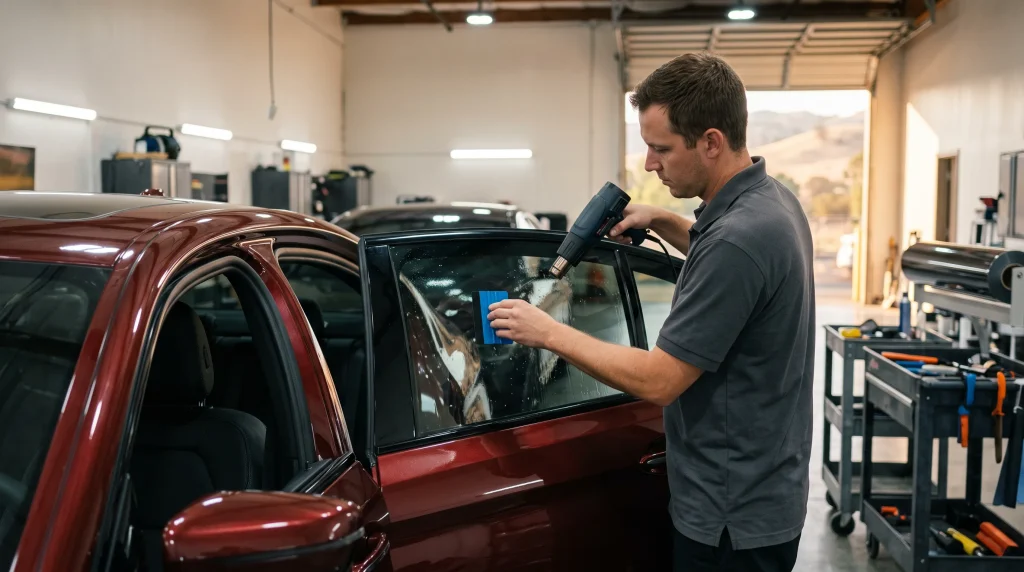
The existing glass still affects final VLT.
Ask the installer to look at your vehicle before deciding which shade best matches your goal.
Choosing Tint for Cars Trucks SUVs and EVs
Different vehicles create different tint decisions.
Sedans
A sedan may have large front and rear glass areas with no factory privacy glass.
Rear shades can be selected for privacy and heat while front glass must follow California requirements.
SUVs
Many SUVs already have darker rear glass.
A ceramic film can be considered for eligible rear windows when solar performance matters in addition to appearance.
Trucks
Crew-cab trucks often have large side windows, which can mean more sun exposure for passengers.
Teslas and Other EVs
EVs can have large glass areas and owners may place greater focus on heat rejection and UV filtering.
Royal Tint also works with Tesla window tinting and Rayno Nano Carbon Ceramic film.
No matter what you drive, California law follows the location and condition of the window.
It does not change because the vehicle is a luxury car, truck, SUV, or EV.
Window Tinting Near Auburn, CA
Royal Tint serves drivers from Auburn, CA, Sacramento, CA, Rocklin, CA & Rancho Cordova, CA.
For Auburn drivers, our Rocklin shop is the closer Royal Tint location:
Royal Tint Rocklin
5600 Pacific St Suite 100
Rocklin, CA 95677
(916) 840-0030
Our second shop is:
Royal Tint Sacramento / Rancho Cordova
3515 Sunrise Blvd Suite #21
Rancho Cordova, CA 95742
(916) 502-2994
Royal Tint also serves drivers from Roseville, CA, Granite Bay, CA, Loomis, CA, Lincoln, CA, Newcastle, CA, Citrus Heights, CA, Fair Oaks, CA, Folsom, CA, Orangevale, CA, Carmichael, CA, and El Dorado Hills, CA.
Royal Tint is a Rayno Elite Dealer and uses certified installers.
Our services include:
- Window tinting
- Paint Protection Film
- Ceramic coating
- Paint correction and detailing
- Windshield protection film
Based on the business information supplied by Royal Tint, the two locations have more than 700 combined customer reviews with a 5-star rating.
If you are comparing window tinting in Auburn, CA, tell Royal Tint what matters most to you: heat, glare, UV filtering, privacy, appearance, or a mix of these goals.
Call (916) 840-0030 for Rocklin or (916) 502-2994 for Rancho Cordova.
You can also contact Royal Tint online.
Window Tinting FAQs
1. What window tint is legal in California?
California treats each window differently. Qualifying clear and colorless material installed on the front side windows must have at least 88% VLT, while the finished glass and film must meet the federal 70% minimum light-transmission requirement. Side windows behind the driver are exempt from the general restriction, and rear-window tint is allowed when qualifying outside mirrors are installed on both sides.
2. Can I put 35% tint on my front side windows in California?
Ordinary 35% dark aftermarket film does not meet the clear, colorless front-side exception in California Vehicle Code Section 26708. That exception requires qualifying material with at least 88% VLT and a finished glass-and-film combination that meets the 70% federal minimum.
3. Can I use dark tint on the rear windows in California?
California Vehicle Code Section 26708 exempts side windows behind the driver from the general tint restriction. The rear window may also use tint when the vehicle has qualifying outside mirrors on both sides.
4. Can I tint the whole windshield in California?
Ordinary dark aftermarket tint across the main windshield viewing area is restricted. California permits qualifying material along the upper portion of the windshield under the placement, color, lettering, and reflection rules in Vehicle Code Section 26708. A separate medical provision exists for qualifying clear material.
5. Is ceramic tint better for Auburn heat?
Ceramic film can offer high infrared rejection without requiring the darkest appearance. Rayno Phantom S9 currently lists infrared rejection around 91% to 93% across several shades, while Phantom II is rated by Rayno at up to 97% infrared rejection depending on the product.
6. Does darker window tint always block more heat?
No. VLT and heat rejection are separate measurements. A lighter high-performance carbon ceramic film can reject substantial infrared energy while allowing more visible light than a darker film.
7. Where can I get window tinting near Auburn, CA?
Royal Tint serves Auburn drivers from our Rocklin location at 5600 Pacific St Suite 100, Rocklin, CA 95677. Call (916) 840-0030 for Rocklin or (916) 502-2994 for Rancho Cordova. You can also contact Royal Tint online to schedule a tint appointment.
Choose Film Performance and Legal Shade Together
Window tinting in Auburn, CA is easier to choose when you separate three questions.
How dark do you want the glass?
How much solar heat do you want the film to reject?
What does California law allow on that window?
Those questions do not always lead to the same film.
A darker window is not automatically the strongest heat-rejecting choice.
A legal rear-window shade may not be allowed on the front side windows.
Factory privacy glass does not necessarily provide the same solar performance as a high-performance ceramic film.
Royal Tint installs Rayno Nano Carbon Ceramic window tint for drivers from Auburn, CA, Sacramento, CA, Rocklin, CA & Rancho Cordova, CA.
Call our Rocklin location at (916) 840-0030 or Rancho Cordova at (916) 502-2994.
You can also contact Royal Tint online to compare Rayno films and choose an option suited to your vehicle, driving habits, heat-control goals, and California requirements.
Sources
- California Vehicle Code Section 26708
Publisher: California Legislative Information
Publication Date: Amended by Stats. 2025, Ch. 417, effective January 1, 2026
Used for: Front side window requirements, 88% VLT rule, 70% finished glazing requirement, rear side window exception, rear-window mirror requirement, windshield strip requirements, certificates, and medical provisions. - California Highway Patrol FAQ
Publisher: California Highway Patrol
Publication Date: Current webpage
Used for: CHP guidance regarding aftermarket tint on the windshield, front side windows, rear glass, and outside mirror requirements. - Rayno Phantom Series
Publisher: Rayno Window Film
Publication Date: Current product page
Used for: Phantom S5, S7, and S9 VLT choices, TSER, infrared rejection, UV rejection, Nano Carbon Ceramic construction, clarity, and color-stability information. - Rayno Phantom II
Publisher: Rayno Window Film
Publication Date: Current product page
Used for: Phantom II Nano Carbon Ceramic technology, up to 97% infrared rejection, 99.9% UV rejection, clarity, and fading information. - Sacramento Climate Summary, July 2026
Publisher: National Weather Service Sacramento
Publication Date: August 1, 2026
Used for: Sacramento-region summer heat context, July 2026 average maximum temperature, and number of 90-degree days. - Royal Tint Window Tinting
Publisher: Royal Tint
Publication Date: Current website page
Used for: Rayno automotive window film, Royal Tint window tinting services, internal links, and film information. - About Royal Tint
Publisher: Royal Tint
Publication Date: Current website page
Used for: Rayno Elite Dealer status, certified installers, company history, Rocklin and Rancho Cordova locations, and phone numbers. - Contact Royal Tint
Publisher: Royal Tint
Publication Date: Current website page
Used for: Appointment requests and contact information.